
dev · open-source · ai
LibHunt: requirements, how to submit, and what you actually get
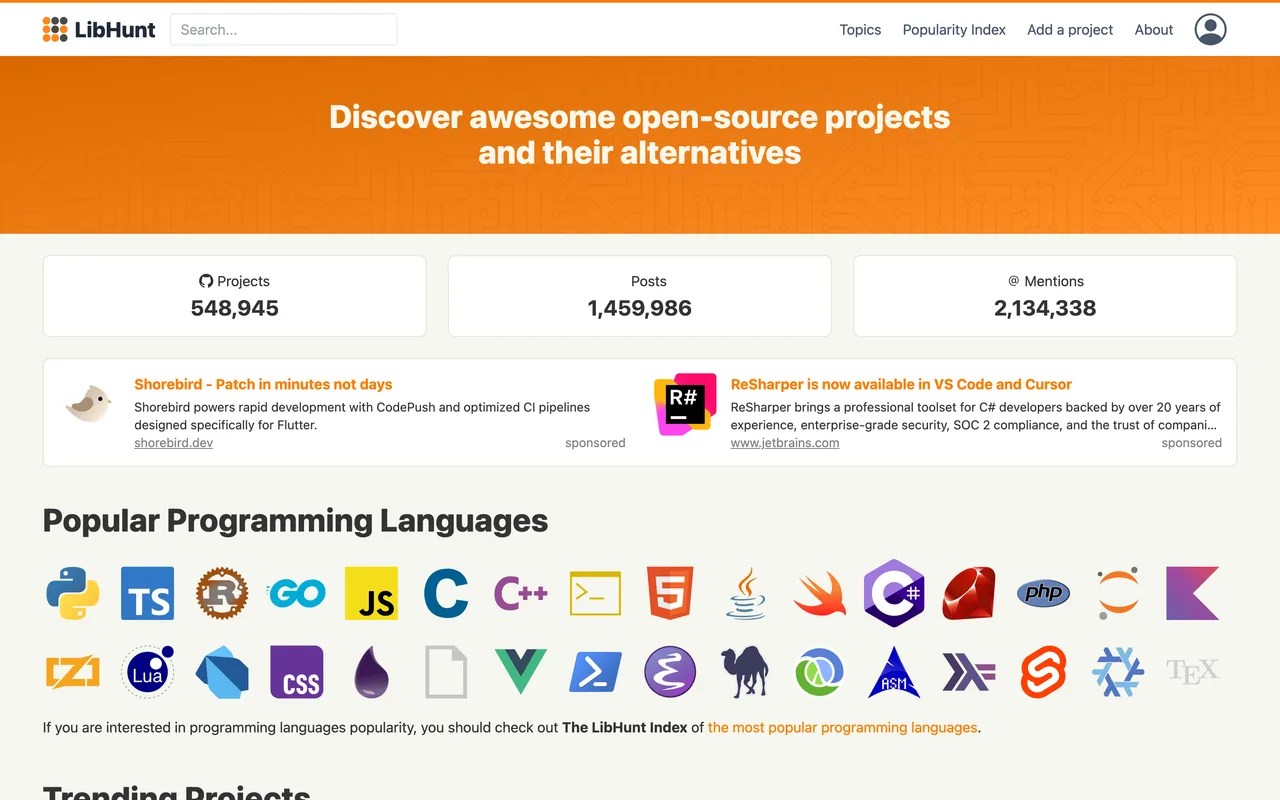
A tracker of open-source projects that takes a repository URL, approves it on the spot, and links out followed.
libhunt.com
Eligibility
Who LibHunt accepts
You need
A public repository URL, which is the only thing the first screen asks for
A one or two sentence description, which is what their form asks for by name
You'll be rejected if
A hosted product with no public repository, since the whole record is built around a repo URL
Open source projectsDeveloper toolsMCP servers
What you actually get
A project page with your description, topics, website and docs links, listed among alternatives and similar projects and folded into their popularity index. Both outbound anchors on the page carry no rel at all, so the links to the repo and to your site are followed.
How to submit to LibHunt
1
Paste the repository URL
The first screen is one field and a Continue button. No account is asked for at any point.
2
Fill the details it could not read
Name, a one or two sentence description, comma-separated topics, an official website URL, a docs URL, the language and the licence.
3
Decide the self-hosted question honestly
One checkbox, described as being for full-featured software that runs on its own rather than a library or package. A hosted service is not that.
4
Submit, and it is live
The confirmation says the submission has been approved automatically, and drops you on a page inviting you to suggest an alternative to your own project.
LibHunt requirements
A public repository URL
A one or two sentence description
Topics, website URL, docs URL, language and licenceoptional
Gotchas
It is a library tracker, not a launch board. Their own description is that they track mentions of software libraries on social networks, so a project nobody discusses will sit there unranked rather than get an audience.
The self-hosted checkbox is about whether the thing runs on its own, not about where you host it. A hosted service with a metadata-only repo is neither a library nor self-hosted software, which is a gap their form has no answer for.
Approval is automatic, so whatever you type is what the page says immediately. There is no review to catch a description you would have rewritten.
Let your agent submit to LibHunt
Connect SubmitMap to your AI over MCP and this page stops being something you read and copy. Your agent asks for the LibHunt playbook and gets the brief for this exact form, with the values already taken from your submission pack instead of placeholders you fill in by hand.
What it does for this platform
Checks your product against the 3 LibHunt rules above, so you find out you would be rejected before you open a tab.
Hands your agent all 3 fields this form asks for, 1 of them optional, already filled from your pack.
Types it into LibHunt in your own browser, and stops for you when the form wants a sign-in.
Records what it sent, so the dashboard can answer "did I ever submit to LibHunt?".
Connect your agentTools and endpointsWorks with Claude Code, Claude, Codex, Cursor, VS Code and Hermes.
LibHunt FAQ
How long does LibHunt approval take?
LibHunt's typical time from submission to going live is instant.
How much does it cost to submit to LibHunt?
Submitting to LibHunt is free.
Does LibHunt give a dofollow backlink?
Yes, a listing on LibHunt carries a dofollow link. The site has a domain rating of 66.
Does LibHunt require a backlink to your site?
No, LibHunt does not require a link back from your site.
What gets you rejected from LibHunt?
A hosted product with no public repository, since the whole record is built around a repo URL.